
Loft Boarding Installation Fleet
Raised loft boarding for storage in Fleet homes
At Loft Insulation Specialists, we help Fleet homeowners keep more of their belongings in the loft with loft boarding. Raised legs fixed to the joists carry the boards, keeping them above the insulation instead of pressing on it. About four in five homes in the town are houses rather than flats. A house usually has a loft of its own for us to board.
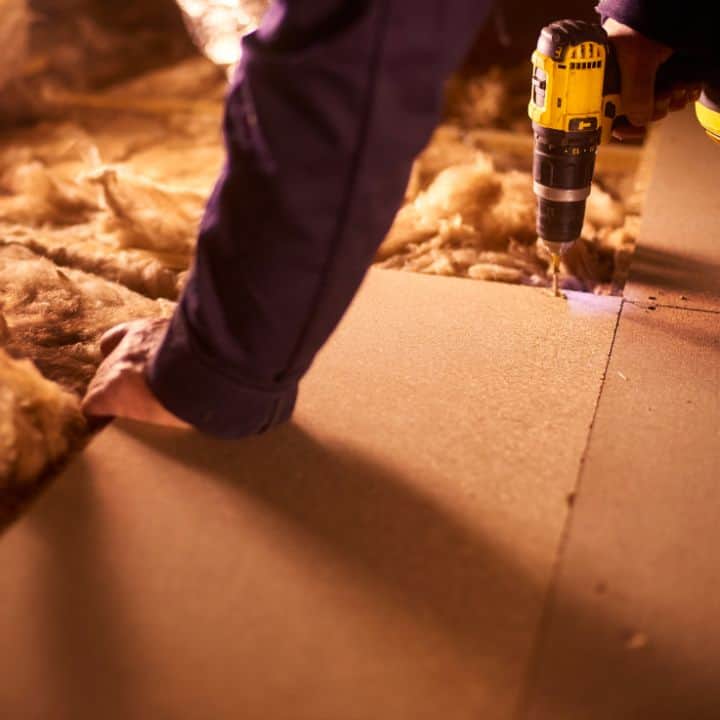
How Fleet homeowners benefit from Loft Boarding
A raised floor gives your Fleet loft storage clear of the insulation. Over two in five of the town’s homes date from the early 1980s or later. In those homes, the floor usually stands on factory-made roof trusses.
Room for everything that doesn't fit downstairs
With boards down, your loft gives you somewhere to keep the belongings now filling cupboards and wardrobes below. The boards reach the hatch, where you can set each box down as soon as you lift it in.
A warmer home, because the insulation stays at full depth
Squashed insulation, mineral wool included, insulates less, which is why we raise the boards on legs above the quilt. At the survey we pick legs tall enough to clear the quilt’s full depth. A high-load electrical cable belongs on top of the insulation, since burying the cable is a fire risk. A raised floor leaves the cable there. On that visit we also look for damp or flattened quilt, which nobody could see under boards.
A floor the joists can carry, with the ceiling below kept sound
Stored belongings bear on the ceiling joists, or on a truss’s ceiling tie, which is the timber that carries stored things and water tanks. We never cut or trim a truss. Most North Fleet houses, from the 1890s to the early 1920s, predate trussed rafters, and their joists usually carry the floor. Joists, not boards, usually limit what a loft can hold, and overloading could bend them and crack the ceiling. At the survey, we check your joists or ties and advise on weight.
Reach the tank and the boxes without risking the ceiling
Where a loft has no boards, you get to the tank or a junction box by treading on one joist after another. Deep quilt can cover the joists completely. A foot placed between them can go through the ceiling of the room underneath. Secure boards to walk on give you a safe way across wherever insulation covers the joists or the tank lies far from the hatch. We set access points into the boards next to the tank and the junction boxes.
Air kept moving, which keeps stored things and timbers from sitting damp
Air passes over the quilt through a small ventilation gap we leave beneath the boards. Our boards end short of the eaves, and the ventilation openings along the eaves and at the ridge stay open. The airflow lowers the chance of condensation, which can rot roof timbers and leave stored belongings damp or mouldy.
How our Loft Boarding service works in Fleet
Take a look below to find out how our Loft Boarding service works in Fleet,
- 1
Book your free Fleet survey
You book a free, no-obligation survey, and during it we inspect the loft you want boarded at your Fleet home.
At the visit, we check the joists’ size, spacing and condition, and measure the depth of insulation that the legs must rise above.
After the survey, we tell you how much floor we can board, the weight it should carry, and whether to top up or clear the insulation first.
- 2
Receive your fixed price quote
The floor area we board and our fitting method set your fixed-price quote, and we match the method to the quilt depth already in the loft.
Materials and labour are both in the quote, along with the boards, fixings and raised supports.
If we ever believe your property isn’t suitable, we’ll tell you upfront. We tell you this at the survey visit, before we prepare a quote.
- 3
Professional Loft Boarding service provided
Our two-person team fits the raised floor in 1–2 days.
We fix the legs to the joists, setting any leg on an uneven joist level, and lay 18mm chipboard or OSB (oriented strand board) on top, cutting it round pipes and cables.
By the time we go, the floor is level and the eaves are open, with access points next to the tank and junction boxes.
How much does Loft Boarding cost in Fleet?
Boarding a Fleet loft with Loft Insulation Specialists costs £600–£2,000. We charge £60–£75 per square metre. The more floor we board, the higher your price sits in that range. Nearly half the town’s homes are detached, and their lofts usually take more boards than a semi’s, which raises the price. After the survey, your fixed-price quote sets out the floor we have measured.
The Fleet suburbs we provide Loft Boarding services to:
Ancells Park, Bramshot Farm, Church Crookham, Crookham Village, Elvetham Heath, Pondtail
Our services in Fleet
Loft Boarding Installation Fleet Nearby
Why Choose us for Loft Boarding in Fleet?
Award-Winning Services
We have been recognised as the 'Best Loft Insulation Installation Firm 2023 – Hampshire' by the Southern Enterprise Awards, an independent awarding body.

Guaranteed energy savings
We guarantee up to 35% lower energy bills by slashing heat loss, backed by our free survey, transparent results and full satisfaction pledge.
Proven Accredited Reliability
Checkatrade and Google reviews from Hampshire locals verify our punctuality, spotless sites and top-quality services - independent proof we deliver every time.
True Local Hampshire Experts
Fast same-week surveys and quotes, as well as tailored solutions for local projects mean quicker installs and better results than out-of-area firms.
40+ years of experience
With over 40 years of experience in insulation and home improvements, our team quickly diagnoses issues, gives better advice, and delivers installations done right the first time.
No-obligation surveys
Our surveys are always free with zero obligation. No high-pressure sales or jargon: just straightforward facts and options, respecting your decision every time.







Frequently asked questions
Take a look at the Frequently Asked Questions regarding our Loft Boarding services in Fleet.
Can I use my boarded Fleet loft as a room?
No. A boarded loft is for storage, and making it a bedroom would turn it into a loft conversion. A loft room cannot have a retractable ladder as its escape route under Approved Document K, official guidance on stairs and ladders. An alteration that leaves a home’s structure or fire safety less compliant with the Building Regulations counts as building work. At the survey, we check whether you need building control approval. Where a home is not listed, internal alterations need no planning permission, but a listing usually covers the interior. A listed home needs the council’s listed building consent for work affecting its character.
What has to come out of my Fleet loft before boarding?
The loft must be empty before our team arrives, as we work across the whole floor to fix the legs and lay the boards. Either you clear it yourself, or you book our loft clean-out and our team does the emptying. Anything you are keeping, we carry down to the rooms below, and we take away the rest along with any spoiled insulation or debris. While the job is under way, the team does not shift stored belongings aside.
Should the insulation be topped up before my Fleet loft is boarded?
Usually yes, if we find at the survey that the joists have insulation between them and none on top. That layer alone may not be enough for modern recommended levels, and we add a second across the joists before we board. Approved Document L, the government’s energy-saving guidance, points out that insulation may not be practical beneath boards kept in place. To insulate later, we would take the boards up and put them back higher. We add a Knauf Earthwool or Superfoil top-up as part of our loft insulation service, during the boarding visit if you want it.
How much floor do Fleet lofts leave for boarding?
Bungalows in south-east Pondtail and on some 1960s and 1970s Church Crookham estates usually have the most floor for their size, since their roof spans the whole home. Pondtail’s inter-war semis with hipped roofs usually have a wide floor, though struts break it up and each hip shortens it. North Fleet’s steep tiled roofs usually leave central headroom. South Fleet’s 1940s and 1950s semis with half-hipped roofs, and a shallow-roofed mid-to-late-1960s West Fleet estate, usually leave a narrower strip. Most homes built since the mid-1970s have trussed roofs, as do some from the mid-1960s. We board trussed lofts in runs between the webs, the diagonal braces. A room in the roof usually leaves just the eaves voids and a small apex space. We measure your loft at the survey.
How soon can you survey my Fleet loft for boarding?
We can usually survey a Fleet loft for boarding within a week of the enquiry, since we offer same-week surveys and quotes. To book the free, no-obligation survey, phone us on 023 9326 7900 or send a message via the website. We inspect the joists, the insulation and the hatch while we are with you. Our Fleet service area page sets out everything else we do in the town.
About Fleet
Fleet
Featured Business LocationLoft Insulation Specialists near Fleet
general contractor, manufacturer, service
5 stars (8 reviews)Phone: 023 9326 7900Nearby Suburbs