
Cavity Wall Insulation Hook
Cavity wall insulation for Hook homes with unfilled cavities
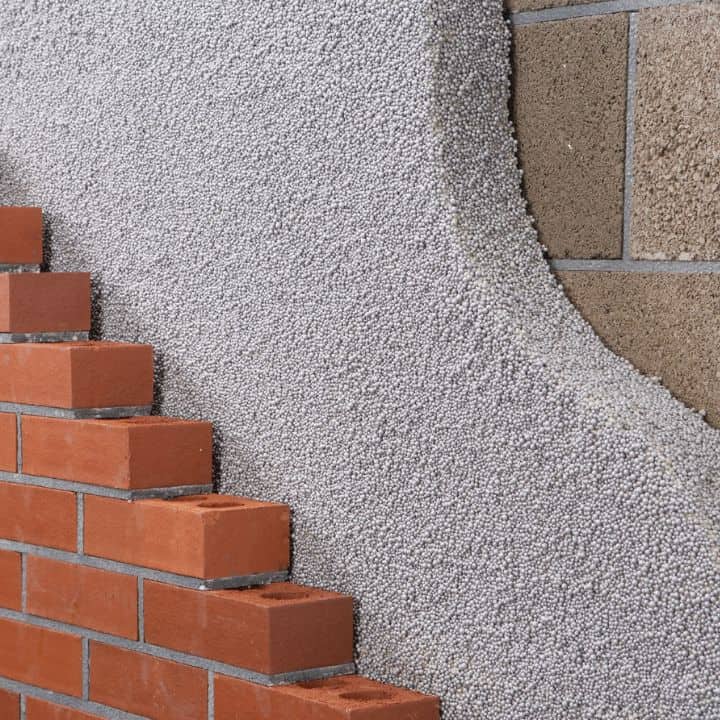
At Loft Insulation Specialists, we help Hook homeowners fill the gap inside their outside walls with cavity wall insulation. That gap is the cavity, between an outer leaf, usually brick, and an inner leaf of brick or concrete block. Through small holes drilled in the outside wall, we blow in Superbead EPS, a bonded expanded-polystyrene bead. Fewer than one home in ten in the village was built before the 1940s, and houses newer than the 1920s probably have a cavity in their outside walls. We check at the survey whether yours has one, and whether it is still empty.
How Hook homeowners benefit from Cavity Wall Insulation
When we fill an empty cavity, a Hook home keeps more warmth in its rooms. Once we confirm at the survey that your cavity suits filling, a filled cavity also gives you the benefits below.
Warmer rooms with no floor space given up
A filled cavity lets less heat escape through your outside walls, and your rooms lose no space. An inside lining on a solid wall takes floor area from each room. Approved Document L, the guidance on energy standards for building work, accepts that loss only within limits. Detached houses are the commonest home in Hook, and with no shared wall, each loses heat through all four sides. A semi has three outside walls, and a mid-terrace its front and back.
Insulated walls that look the same from outside
In brickwork, we drill the holes in the mortar joints and fill them with colour-matched mortar. Some of Hook’s 1960s to 1980s houses also have tile hanging or weatherboarding, and we make good every outside surface and leave it as it was. Insulation that leaves the outside unchanged does not normally need planning permission. Several listed buildings stand in Hook Historic Core. If your home is one of them, or is in a conservation area, check with the council before work starts.
A filled cavity that still lets rainwater drain away
Rain can cross a filled wall by tracking over a bridge, such as rubble at the base of the cavity, or by soaking through the insulation. EPS bead does not absorb water, which makes soaking less likely than with blown mineral wool. Water that does get into Superbead EPS runs down the gaps between the beads to the ground.
Walls checked inside the cavity before any drilling
We check the cavity and the ties linking its leaves with a borescope camera at the survey. Ties in walls built before the 1980s can corrode, cracking the mortar and letting damp in. Ties are most at risk in about a third of Hook homes, those built up to the early 1980s. A cavity under 50mm wide is generally considered too narrow to fill, and one worth filling is clear of rubble, in sound brickwork. For a solid wall or narrow cavity, loft insulation is among the cheapest and easiest energy-efficiency measures, and with care it suits older buildings too.
Your semi or terrace insulated without waiting for next door
Over a third of Hook households live in a semi or a terraced house. Where your outside walls join next door, a cavity barrier keeps the insulation on your side. We fit that barrier, or a cavity brush, on each dividing line. North Hook’s 1980s estate has terraces built back to back in blocks of six. Where one house in such a block has a cavity that suits filling, we can fill it without the other five.
How our Cavity Wall Insulation service works in Hook
Take a look below to find out how our Cavity Wall Insulation service works in Hook,
- 1
Book your free Hook survey
You ask for a free, no-obligation survey, and we visit your Hook home to examine its outside walls.
We check how wide the cavity is and look for debris or insulation already in it.
Next, we tell you whether Superbead EPS is right for your walls, and whether the brickwork or pointing, the mortar between the bricks, needs repair first.
- 2
Receive your fixed price quote
We then send a fixed-price quote. The area of outside wall to fill and how easily the team can reach it set the figure.
Your quote includes all materials and labour, the sealing of every drill hole too, with no hidden extras.
If we ever believe your property isn’t suitable, we’ll tell you upfront. We explain why, such as a cavity too narrow or already filled.
- 3
Professional Cavity Wall Insulation service provided
The team does all the work from outside and usually fills your walls in 2–4 hours.
The team drills along the mortar joints and injects the beads one section at a time, watching until the cavity is full.
The team removes its debris. We then walk round the finished walls with you and explain the 10-year guarantee from the IAA, the Installation Assurance Authority.
How much does Cavity Wall Insulation cost in Hook?
For a Hook home, Superbead EPS cavity wall insulation from Loft Insulation Specialists costs £1,250–£3,500. The area of outside wall we fill and how high the team must work set where your price falls in that range. A detached house has more outside wall for its size than a semi or a mid-terrace, and a third storey means the team works higher. Once we have surveyed, we fix the price, and the price you accept is the price you pay.
The Hook suburbs we provide Cavity Wall Insulation services to:
Newnham, North Warnborough, Odiham
Our services in Hook
Cavity Wall Insulation Hook Nearby
Why Choose us for Cavity Wall Insulation in Hook?
Award-Winning Services
We have been recognised as the 'Best Loft Insulation Installation Firm 2023 – Hampshire' by the Southern Enterprise Awards, an independent awarding body.

Guaranteed energy savings
We guarantee up to 35% lower energy bills by slashing heat loss, backed by our free survey, transparent results and full satisfaction pledge.
Proven Accredited Reliability
Checkatrade and Google reviews from Hampshire locals verify our punctuality, spotless sites and top-quality services - independent proof we deliver every time.
True Local Hampshire Experts
Fast same-week surveys and quotes, as well as tailored solutions for local projects mean quicker installs and better results than out-of-area firms.
40+ years of experience
With over 40 years of experience in insulation and home improvements, our team quickly diagnoses issues, gives better advice, and delivers installations done right the first time.
No-obligation surveys
Our surveys are always free with zero obligation. No high-pressure sales or jargon: just straightforward facts and options, respecting your decision every time.







Frequently asked questions
Take a look at the Frequently Asked Questions regarding our Cavity Wall Insulation services in Hook.
Do the Building Regulations cover filling cavity walls in Hook?
Yes, the Building Regulations count putting insulation into a cavity wall as building work. The work is either notified to building control, which checks building work, or self-certified by an installer registered with a competent person scheme the Building Regulations list. On our jobs, the installation is registered and certified under a competent person scheme, which means you do not apply to building control yourself. For a listed or conservation-area home, Approved Document L does not demand its full energy standards where meeting them would unacceptably change the home’s character or appearance. Listed building consent is a separate matter, which you apply for through the council.
How can I tell if my Hook home has cavity walls?
You can often tell from the brickwork whether your home has cavity walls. Cavity-wall bricks usually all run lengthways. A solid wall shows the short ends of some bricks. At a door or window, a cavity wall probably measures thicker than a solid one. Some cavity walls were built in a solid-wall pattern, making the pattern only a sign. Many of Hook’s 1960s and 1970s houses are tile-hung upstairs, but their ground-floor brickwork still shows the pattern. Render or cladding covers the pattern, and we make the professional check such walls need at the survey.
Can a Hook flat or maisonette have cavity wall insulation?
Yes, as part of the whole block: a flat or maisonette cannot have its cavity walls filled on its own. The block’s outside walls are filled as one job, which means every household, and the freeholder or management company, has to agree to the work first.
Which Hook homes have cavity walls that can be filled?
North Hook and East Hook’s 1960s and 1970s houses are among the likeliest to have an empty cavity. Most homes in England built since the mid-1940s are cavity-walled, though pre-1990s ones may lack insulation. Early 1980s to late 1990s homes fall either side of that point, and we check whose cavities are filled. This century’s estates, such as Holt Park, Green Hart Park and Oakwood Grange, generally have insulation. Victorian and Edwardian red-brick houses around Jubilee Green are more likely solid-walled, and filling an early, narrow cavity risks damp inside. Hook Historic Core’s 1970s brown-brick sheltered flats, if their walls suit, go as whole blocks. Render or roughcast covers some inter-war and post-war council homes in South Hook and Hook Historic Core, which we check at the survey.
How quickly can my Hook walls be surveyed?
We usually survey your Hook walls in the same week you contact us, as same-week surveys and quotes are part of our service. Book a free, no-obligation survey on 023 9326 7900 or through the enquiry form. At the visit, we find out if your walls have a cavity, how wide any cavity is and whether rubble or insulation is already in it. Everything else we install in the village is on our Hook service area page.
About Hook
Hook
Featured Business LocationLoft Insulation Specialists near Hook
general contractor, manufacturer, service
5 stars (8 reviews)Phone: 023 9326 7900Nearby Suburbs