
Roof Insulation Portsmouth
Roof insulation at the rafters of Portsmouth homes
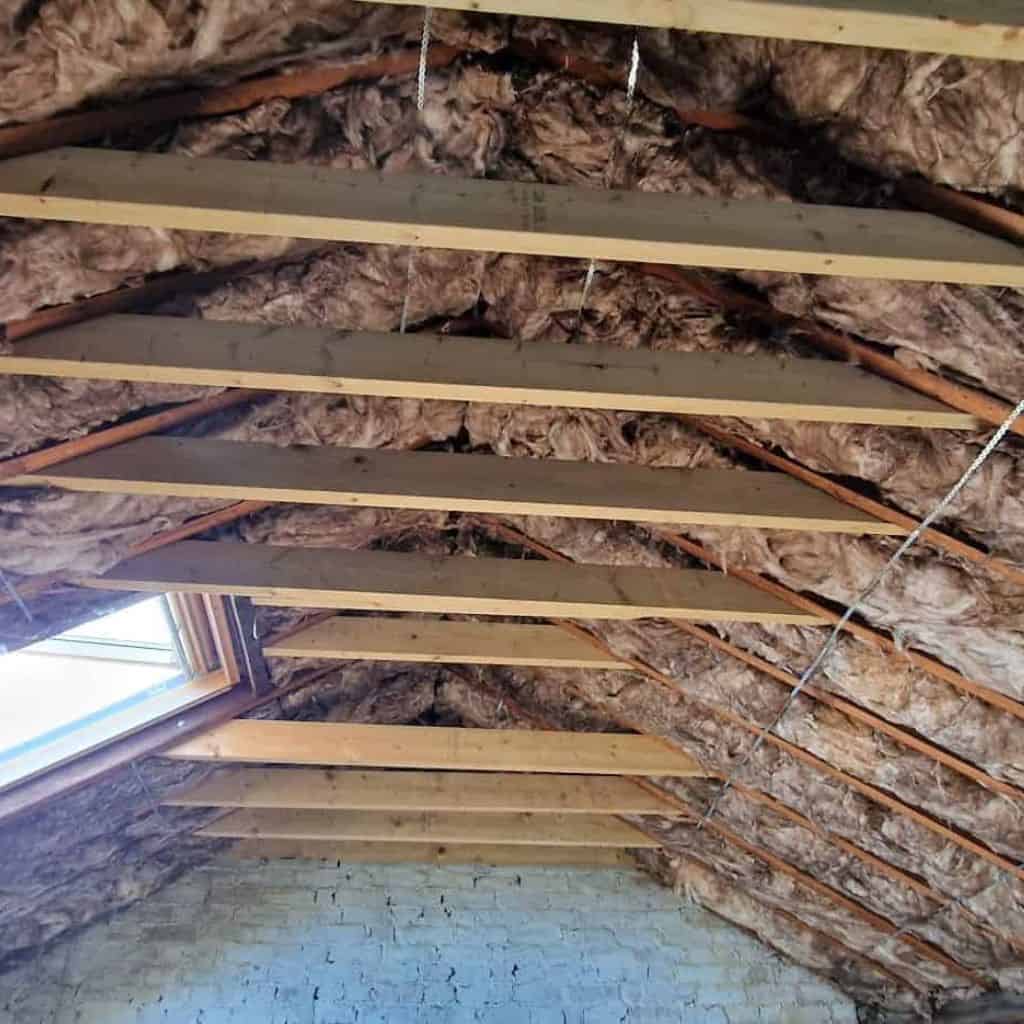
At Loft Insulation Specialists, we help Portsmouth homeowners who still use their loft, or have a room in the roof, by fitting roof insulation in Knauf Earthwool or Superfoil. We place wool between the rafters or fix foil across their face, which moves the insulated layer from the loft floor into the roof slope. Pre-1919 homes make up two in five of the city’s total, and across England, rooms in the roof, original or converted, are commonest in homes of that age, and we insulate such rooms at the rafters.
How Portsmouth homeowners benefit from Roof Insulation
We can insulate a Portsmouth home at the rafters and leave the outside of its roof as it is, and that is one of the five benefits below.
A loft space warm enough to keep using
Rafter insulation keeps the loft space warmer, which lowers the risk of frozen pipes or a frozen water tank. A party wall, gable wall or chimney breast in the loft needs insulating too, or heat leaks past the new layer through it. Over two in five Portsmouth households live in terraced houses, whose lofts usually have a party wall to insulate on each side, or on one at the end of a row. If the loft stays empty and unused, we cover the loft floor with 300mm of Knauf Earthwool under our loft insulation service.
Bedrooms under the slope that hold their heat
In a room in the roof, such as a bedroom lit by a dormer or the upper floor of a chalet bungalow, only a sloping ceiling and the rafters separate the room from the tiles. In winter, Knauf Earthwool fitted between those rafters slows the heat the room loses through the slope. When Superfoil also goes across the rafters, its foil turns back the sun’s heat coming through the tiles in summer.
Insulated without trapping moisture in the roof timbers
Insulation pressed against the tiles or felt is more prone to condensation and to getting wet. The Knauf Earthwool we fit sits between the rafters clear of the covering. Air can then rise behind it through the ventilation path between the eaves and the ridge. Behind any Superfoil, we keep that path open too. According to SuperFOIL, each of its multifoils works as a vapour control layer (VCL), and properly installed, it reduces the risk of condensation.
Earthwool, Superfoil or both, sized to your rafters
The depth of your rafters limits how much Knauf Earthwool fits between them. Shallow rafters hold a thinner layer of wool. We add Superfoil across their faces in one continuous sheet, which stops the ceiling coming far into the room. Approved Document L, the Building Regulations guidance for energy efficiency, sets a roof standard. On work it covers, a lesser standard may be appropriate where meeting that standard would reduce headroom. The allowance needs the insulation and any air gap to fill the rafter depth. See our Superfoil insulation page for the sheet alone.
Fitted from inside, with the tiles left where they are
We work from inside your home, through the loft or a room below the rafters, and need no scaffold. If insulation is laid over the rafters instead, the roof covering can sit differently against walls and chimneys and at the eaves. Working from inside, we leave your slates or tiles, and any felt beneath them, in place.
How our Roof Insulation service works in Portsmouth
Take a look below to find out how our Roof Insulation service works in Portsmouth,
- 1
Book your free Portsmouth survey
When you contact us, we arrange your free, no-obligation survey in Portsmouth. At the survey, we look at every roof slope from inside the loft and from the rooms below it.
We measure rafter depth and spacing on every slope, and trace the air path in from the eaves. For a slope plastered as a ceiling, we say what it needs.
From the measurements, we tell you whether your roof needs insulating at the rafters or across the loft floor. We also say which suits your rafters: Knauf Earthwool or Superfoil, or both.
- 2
Receive your fixed price quote
We set your fixed-price quote from our survey measurements. The quote reflects the size of each roof slope, the access we need to it and the materials we recommend.
Your quote covers both materials and labour, with no hidden extras, for wool, foil or the two combined.
If we ever believe your property isn’t suitable, we’ll tell you upfront. Any roof we insulate must be dry and in good condition first.
- 3
Professional Roof Insulation service provided
Given good access to the roof, most jobs take our two-person team 4–6 hours.
We lay protective sheeting in any room on our route. We cut wool to the rafter spacing, off the felt, or we fix foil across the rafters and tape it.
Before we leave, we sweep the loft and carry our waste out, keeping the air path open from eaves to ridge.
How much does Roof Insulation cost in Portsmouth?
In Portsmouth, we insulate a roof with Knauf Earthwool between the rafters for £900–£1,200, or with Superfoil across them for £1,200–£1,800. The area of slope we insulate sets where your home falls in either range. Some of the city’s pre-1919 terraced houses have a rear addition under a flat roof. Where we insulate that roof too, the price moves up its range. Dormer side walls (the cheeks) and work through a finished room raise it as well. We quote a fixed price once we have surveyed the roof, and it holds on the day.
The Portsmouth suburbs we provide Roof Insulation services to:
Anchorage Park, Buckland, Copnor, Cosham, Drayton, Eastney, Farlington, Fratton, Highbury, Hilsea, Landport, Milton, North End, Old Portsmouth, Paulsgrove, Portsea, Somerstown, Southsea, Stamshaw, Tipner, Wymering
Our services in Portsmouth
Roof Insulation Portsmouth Nearby
Why Choose us for Roof Insulation in Portsmouth?
Award-Winning Services
We have been recognised as the 'Best Loft Insulation Installation Firm 2023 – Hampshire' by the Southern Enterprise Awards, an independent awarding body.

Guaranteed energy savings
We guarantee up to 35% lower energy bills by slashing heat loss, backed by our free survey, transparent results and full satisfaction pledge.
Proven Accredited Reliability
Checkatrade and Google reviews from Hampshire locals verify our punctuality, spotless sites and top-quality services - independent proof we deliver every time.
True Local Hampshire Experts
Fast same-week surveys and quotes, as well as tailored solutions for local projects mean quicker installs and better results than out-of-area firms.
40+ years of experience
With over 40 years of experience in insulation and home improvements, our team quickly diagnoses issues, gives better advice, and delivers installations done right the first time.
No-obligation surveys
Our surveys are always free with zero obligation. No high-pressure sales or jargon: just straightforward facts and options, respecting your decision every time.







Frequently asked questions
Take a look at the Frequently Asked Questions regarding our Roof Insulation services in Portsmouth.
Does roof insulation in Portsmouth need building control?
Roof insulation on a Portsmouth home needs building control when over half of the roof is renovated. Building control applies too when the job belongs to a major renovation, taking in over a quarter of the house’s outer shell. Where feasible, the whole roof should then reach the standard set by Approved Document L, the Building Regulations guidance on saving fuel and power. Its examples of renovation include re-covering a flat roof with a new waterproof layer. We let you know at the survey whether insulating your pitched roof from the inside would count as renovating it. Apart from building control, a listed home can need listed building consent before we insulate its sloping ceilings.
Can I still use my Portsmouth loft after roof insulation?
Yes, your Portsmouth loft stays usable once we have insulated the roof. We fit the insulation to the rafters above, and you keep the use of a boarded floor. Superfoil across the rafters brings the slope’s finished surface slightly further into the loft. How much headroom you would keep is a figure we give you at the survey. The loft must be clear of stored items before the team arrives. You can do the emptying yourself, or we can clear the loft as a separate loft clean-out job.
Do I need roof insulation or loft insulation in Portsmouth?
In Portsmouth, a home needs roof insulation where the roof itself separates its heated rooms from the outside air. The roof is that boundary over a sloping ceiling, a room in the roof, a loft kept in use, a flat-roof extension and a chalet or dormer bungalow. An empty loft over a flat ceiling is different, and we insulate it on the loft floor through our loft insulation service instead. A converted roof may need both. The insulation belongs at the rafters above the room, while the cold eaves space outside its low side walls needs it on the floor.
Which Portsmouth homes need insulation at the rafters?
Insulation at the rafters is probably needed most often in Portsmouth’s pre-1919 and inter-war homes, over half the city’s total. Most homes of those ages have hand-cut roofs, under which rooms in the roof are likelier than under trussed ones. Heat from such a room escapes through its sloping ceilings, which insulation on the loft floor does not cover. Most of the roughly one in five homes built since the early 1980s, and some built from the mid-1960s, have trussed lofts that take their insulation on the floor unless converted. A room in a trussed loft needs structural work first. Over a quarter of Portsmouth households live in purpose-built flats, usually with no private roof slope for us to insulate. We check your roof at the survey.
How do I book a roof insulation survey in Portsmouth?
To book your Portsmouth roof insulation survey, phone 023 9326 7900 or write to us through the enquiry form on our website. We then come to carry out a free, no-obligation survey of your roof slopes. If the diary allows, we offer same-week surveys and quotes. Our other services in the city include cavity wall insulation and loft hatches, and the Portsmouth service area page lists them all.
About Portsmouth
Portsmouth
About PortsmouthPortsmouthCity & unitary authority areaPortsmouth Harbour, including Spinnaker TowerThe GuildhallSouthsea BeachHMS VictoryMary Rose MuseumGunwharf QuaysClarence PierFlagCoat of ArmsNickname: PompeyMotto: Heaven’s Light Our GuideShown within HampshirePortsmouthLocation within the United KingdomCoordinates: 50°48′21″N 01°05′14″W / 50.80583°N 1.08722°W Sovereign state United Kingdom Country England Region South East England Ceremonial county Hampshire Government • Type Unitary authority, city • Governing body Portsmouth City Council • Leadership Leader and Cabinet (No overall council control) • Lord Mayor Gerald Vernon-Jackson • Members of Parliament Stephen Morgan (L)
Amanda Martin (L)[2]Area • City & unitary authority area15.54 sq mi (40.25 km2) Population (2011, 2021)• City & unitary authority area208,100[1][a] • Urban 238,137[4][c] • Metro 855,679 (South Hampshire)[3][b] Ethnicity (2021) [5]• Ethnic groups List- 85.2% White
- 6.9% Asian
- 3.4% Black
- 2.6% Mixed
- 1.8% other
Religion (2021) [5]• Religion List- 47.1% no religion
- 39.4% Christianity
- 6.4% not stated
- 4.9% Islam
- 0.8% Hinduism
- 0.6% other
- 0.5% Buddhism
- 0.2% Sikhism
- 0.1% Judaism
Time zone UTC+0 (GMT) • Summer (DST) UTC+1 (BST) Postal code POArea code 023 ISO 3166 code GB-POR Police Hampshire and Isle of Wight Ambulance South Central Fire Hampshire and Isle of Wight Website portsmouth .gov .uk Portsmouth (/ˈpɔːrtsməθ/ ⓘ PORTS-məth) is a port city and unitary authority in Hampshire, England. Most of Portsmouth is located on Portsea Island, off the south coast of England in the Solent, making Portsmouth the only city in England not located primarily on the mainland. The city is located 22 miles (35 km) south-east of Southampton, 50 miles (80 km) west of Brighton and Hove and 74 miles (119 km) south-west of London. With a population last recorded at 208,100, it is the most densely populated city in the United Kingdom. Portsmouth forms part of the South Hampshire urban area with Gosport, Fareham, Havant, Eastleigh and Southampton.
Portsmouth’s history can be traced to Roman times and it has contained a significant Royal Navy dockyard and base for centuries. Portsmouth was founded c. 1180 by Anglo-Norman merchant Jean de Gisors in the south-west area of Portsea Island, a location now known as Old Portsmouth. Around this time, de Gisors ordered the construction of a chapel dedicated to St Thomas Becket. This became a parish church by the 14th century. Portsmouth was established as a town with a royal charter on 2 May 1194. The city is home to the first drydock ever built. It was constructed by Henry VII in 1496.
Portsmouth has the world’s oldest dry dock, “The Great Stone Dock”; originally built in 1698, rebuilt in 1769 and presently known as “No.5 Dock”. The world’s first mass production line was established at the naval base’s Block Mills which produced pulley blocks for the Royal Navy fleet. By the early-19th century, Portsmouth was the most heavily fortified city in the world, and was considered “the world’s greatest naval port” at the height of the British Empire throughout Pax Britannica. By 1859, a ring of defensive land and sea forts, known as the Palmerston Forts, had been built around Portsmouth in anticipation of an invasion from continental Europe.
In the 20th century, Portsmouth achieved city status on 21 April 1926. During the Second World War, the city was bombed extensively in the Portsmouth Blitz, which resulted in the deaths of 930 people, and it was a pivotal embarkation point for the D-Day landings. In 1982, a large Royal Navy task force departed from Portsmouth for the Falklands War. Her Majesty’s Yacht Britannia was formerly based in Portsmouth and oversaw the transfer of Hong Kong in 1997, after which Britannia was retired from royal service, decommissioned and relocated to Leith as a museum ship.
Featured Business LocationLoft Insulation Specialists near Portsmouth
general contractor, manufacturer, service
5 stars (8 reviews)Phone: 023 9326 7900Nearby Suburbs